
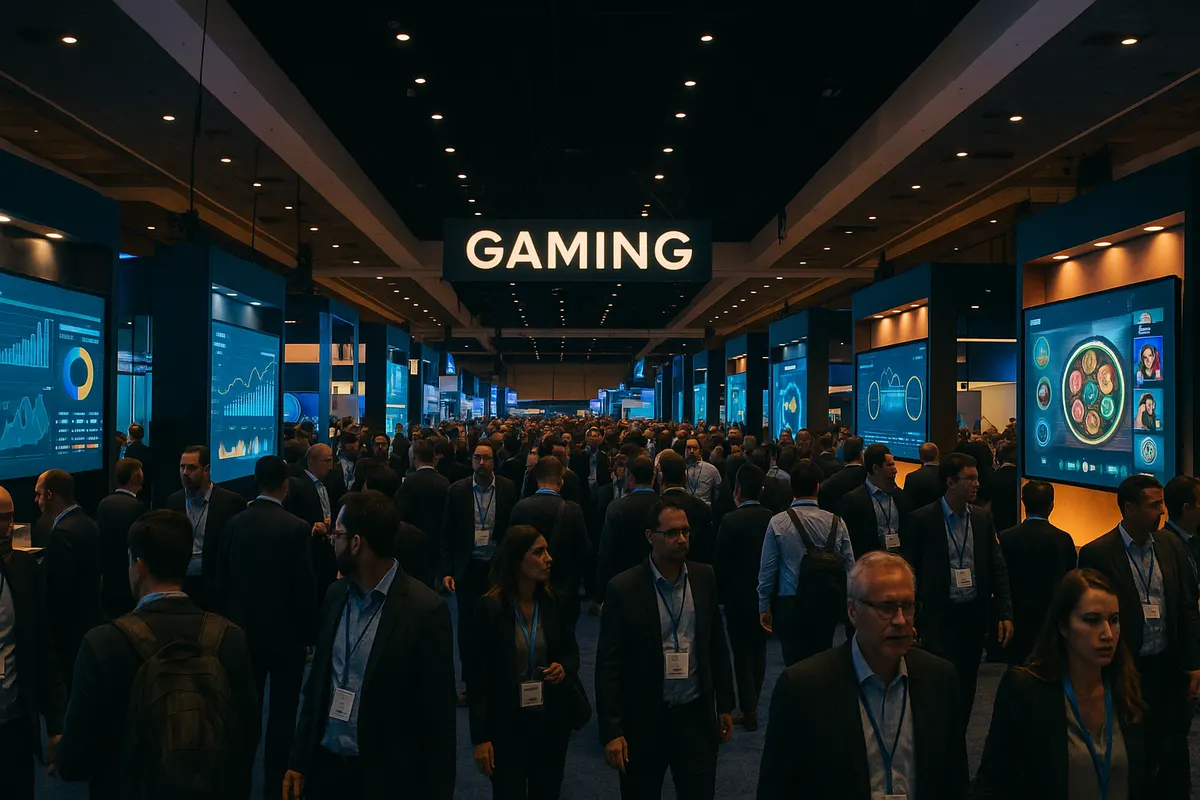
Doors open at 10 a.m. on a Tuesday, and the first thing you notice walking into The Venetian Expo isn’t a slot cabinet. It’s screens. Dashboards, risk models, live odds feeds, probability graphs. The cabinets are still there, of course, but the gravity of the room has shifted.
That shift is the story. If you only take one thing from the G2E trends of 2026, take this: the industry spent its biggest week of the year arguing about software, not hardware. Prediction markets, artificial intelligence and the technology stack underneath betting dominated the agenda, and all three land squarely on the future of online casinos.
G2E 2026 at a glance: the Las Vegas gaming expo goes tech-first
The Global Gaming Expo ran from 28 September to 1 October 2026 at The Venetian Expo in Las Vegas, presented by the American Gaming Association and organised by RX. Organisers put the gathering at more than 25,000 gaming professionals and over 400 exhibitors, with attendees expected from more than 120 countries, regions and territories.
Education sessions kicked off on the Monday; the exhibition floor opened Tuesday morning. Exhibitors covered land-based casinos, iGaming, sports betting, payments, hospitality and enterprise technology. The programme itself told you where the conversation was heading, with prediction markets, AI and new gaming technology set as the headline themes.
For anyone who has walked this floor a few times, that’s a noticeable change of emphasis. A few years ago the buzz was cabinet form factors and jackpot links. This year it was regulatory classification, model governance and payment rails.
Prediction markets move from the margins to the main stage
No topic pulled more attention than prediction markets and their growing presence in the US sports betting landscape. The debate has been especially loaded in Nevada, where regulators have been drawn into questions about how these products sit alongside licensed sportsbooks.
What are prediction markets in gambling?
A prediction market is an exchange where people trade contracts on the outcome of a future event. Each contract settles at a fixed value if the event happens and at nothing if it doesn’t, so its trading price behaves like an implied probability. A contract priced at 60 cents on the dollar implies roughly a 60% chance the market assigns to that outcome.
The mechanics differ from a sportsbook in three ways that matter:
- Who you’re up against. On an exchange you trade against other users. A bookmaker takes the other side of your bet itself.
- How the operator earns. Exchanges typically charge trading or settlement fees. A sportsbook builds a margin, the overround, into its prices.
- Whether you can exit early. Contracts can usually be sold back into the market before the event resolves, so a position can be closed at a profit or a loss mid-event rather than simply won or lost.
None of that removes the cost of participating. Fees and the gap between bid and ask prices are a real drag on returns, and an efficient market prices favourites close to their true probability. If you’re trading because you think the crowd is wrong, you still need to be right more often than your costs.
| Feature | Prediction market | Traditional sportsbook |
|---|---|---|
| Counterparty | Other traders | The operator |
| Operator revenue | Trading and settlement fees | Built-in margin on odds |
| Price format | Contract price implying probability | Decimal, fractional or American odds |
| Exit before settlement | Usually, by selling the contract | Only where cash-out is offered |
| Typical US regulator | Federal derivatives regulation (CFTC) | State gaming regulators |
Who is pushing the category forward
The participants fall into a few camps rather than one. Federally regulated event contract exchanges sit at the centre, supported by brokerages and apps that route retail orders into them. Around that cluster are the data and pricing suppliers who feed both exchanges and sportsbooks, the compliance and surveillance vendors selling market integrity tooling, and licensed betting operators weighing whether to build, partner or lobby.
The unresolved question is legal rather than technical: whether a sports event contract is a derivative under federal oversight by the Commodity Futures Trading Commission or gambling under state law. Until that settles, expect the category to grow in some states and get challenged in others.
AI innovations in iGaming: what was actually on show
AI in iGaming has moved past the demo-video stage. The applications discussed at G2E cluster into three areas you’ll feel as a player, often without noticing.
Personalisation that drives what you see
Machine learning models rank game lobbies, time promotional messages and decide which titles surface for which player. The commercial logic is obvious: a lobby of 4,000 slots is useless without sorting. The uncomfortable part is that the same models optimise engagement, which is exactly why regulators have started asking operators to document how recommendation systems behave around at-risk accounts.
Worth knowing: personalisation changes what you’re shown, never the maths of the game itself. RTP and volatility are properties of the game build and its certification, not of your profile.
Security, fraud and payment risk
This is the least glamorous AI use case and probably the most mature. Models score deposits and withdrawals for fraud patterns, flag bonus abuse and multi-accounting, spot collusion in poker and live table games, and automate parts of KYC document checking. For an honest player, a well-tuned system mostly means fewer manual reviews and faster payouts. A badly tuned one means your withdrawal sits in limbo while a human untangles a false positive.
Responsible gambling tech
Behavioural analytics now underpins much of the responsible gambling toolkit: detecting sharp increases in deposit frequency, chasing patterns after losses, long unbroken sessions, or changes in bet size that break a player’s own baseline. Depending on the jurisdiction, a flag can trigger a reality check, a message, a limit prompt or a forced cool-off.
Useful, but not a substitute for your own controls. Deposit limits, loss limits, session timers and self-exclusion are available in regulated accounts and they work whether or not an operator’s model notices anything. Set them when you’re calm, not mid-session.
Casino technology trends beyond AI
VR and AR: still early, still interesting
Virtual reality casinos remain a small niche with a hardware problem. Headsets are better than they were, but session comfort and cost still limit adoption, and most players reach for a phone. The nearer-term win is augmented layers in live dealer studios, statistics, side-bet overlays and camera switching, delivered to an ordinary screen rather than a headset.
Blockchain, crypto and provable fairness
Blockchain gaming showed up less as a revolution and more as plumbing. Three threads matter: crypto as a deposit and withdrawal option where licensing permits it, provably fair verification letting players check a round’s outcome against published seeds and hashes, and tokenised loyalty schemes. Provably fair is a transparency mechanism, not a better deal. It confirms a result wasn’t tampered with; it doesn’t reduce the house edge.
Next-generation payments
Payments had one of the busier zones on the floor, and the direction of travel is consistent across markets: instant account-to-account rails, real-time payouts, embedded identity verification and smarter routing to lift acceptance rates. In India that story is UPI, where deposits are typically processed within seconds to a few minutes, though timing varies by operator and occasional delays happen. Withdrawal speed increasingly depends on the operator’s internal checks rather than the rail itself. Faster money in and out is convenient, which is precisely why deposit limits are worth using.
What the G2E trends mean for the future of online casinos
Here’s how I’d weight it if you’re a player. The payments and security work will reach you first, probably within a year, and mostly as fewer friction points. Personalisation is already live wherever you play, so the practical question is whether you let a lobby decide your session or you decide it yourself. Prediction markets will reshape sports betting in the US before they touch casino play, though the product idea, trading a position and exiting early, is clearly attractive to younger bettors and will influence how sportsbooks design their own markets.
For operators the harder costs are compliance-shaped. If a model decides who sees which promotion or which account gets flagged for harm, someone has to explain its logic to a regulator and keep records. Expect model governance, auditability and data handling to become ordinary licensing conversations rather than specialist ones.
And the part no technology changes: every casino game carries a house edge, and faster payments, slicker interfaces and smarter recommendations don’t shift it. A 96% RTP slot still returns about ₹96 per ₹100 wagered averaged over millions of spins, not over your evening. Play with money you can afford to lose, use the limit tools in your account, and treat any session as entertainment spending. If gambling stops feeling that way, the self-exclusion and cool-off options exist for exactly that moment.
FAQ
What are prediction markets in gambling?
Exchanges where users trade contracts on future events, with prices that reflect implied probability. You trade against other users rather than against a bookmaker, the platform earns fees instead of a built-in margin, and positions can usually be closed before the event settles.
How is AI changing online casinos?
Mainly behind the scenes: game recommendations and promotional targeting, fraud and bonus-abuse detection, faster KYC checks, automated support, and behavioural models that flag possible gambling harm. It does not alter a game’s RTP or the randomness of outcomes.
What new casino technologies emerged at G2E 2026?
Alongside prediction markets and AI, the expo covered instant payment rails and real-time payouts, blockchain and crypto integration including provably fair verification, loyalty tokenisation, and AR enhancements in live dealer studios, with VR gaming still at an early stage.
Leave a Reply