
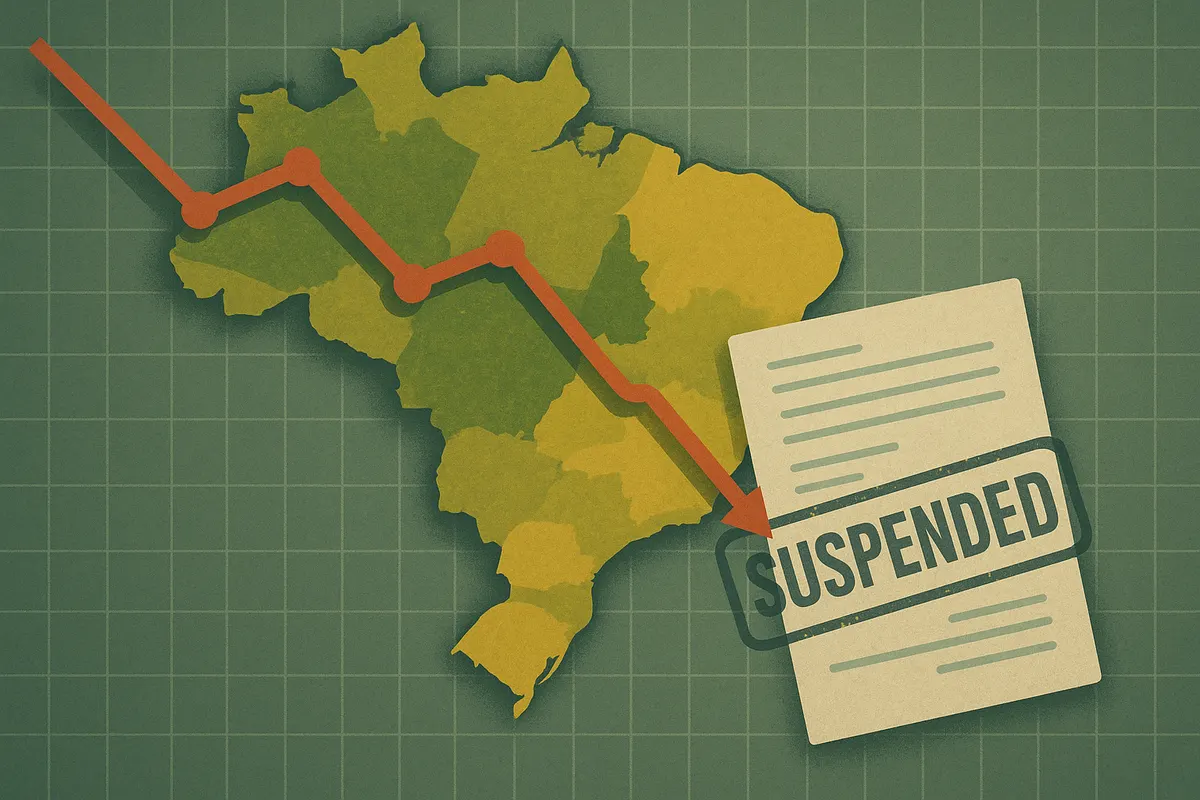
A licence is not a guarantee. That is the lesson operators are absorbing after Brazil’s online gambling ban arrived by provisional measure, signed by President Luiz Inacio Lula da Silva and reported on 28 September 2026, ending a regulated market that global operators had spent years and serious money entering. Within a day, both Flutter Entertainment and Entain had told investors their 2026 numbers would move. Entain cut its full-year online net gaming revenue growth outlook to 4% to 6% and guided underlying earnings to the lower end of its £910 million to £960 million range ($1,203.8 million to $1,270 million). Its shares fell 4% on the FTSE 250 the following Monday afternoon.
The bigger story is not the size of the hit. It is how fast a compliant, licensed, taxed market can be switched off.
What Brazil actually did, and how long it lasts
Brazil prohibited online gambling through a provisional measure rather than ordinary legislation. That matters for two reasons. First, a provisional measure takes effect immediately, which is why operators had to react within days rather than planning through a consultation period. Second, it is temporary by design: the measure must receive congressional approval within 120 days to become permanent. If Congress does not ratify it in that window, it lapses.
The government’s stated rationale is rising gambling addiction in Brazil. That framing is worth taking seriously, because it shapes how similar debates will play out elsewhere. This was not presented as a tax dispute or a licensing clean-up. It was presented as a public health intervention, which is a much harder argument for industry lobbying to push back against.
What operators object to is the process, not the premise. Entain said it would comply with the provisional measure but described itself as “disappointed” by an announcement made, in its words, “without consultation of industry stakeholders regarding its significant adverse consequences.” That is unusually direct language from a London-listed company about a government it still hopes to do business with.
So the immediate position is this: a live prohibition, a 120-day clock, and a legally uncertain outcome. Operators have to plan for a full-year shutdown while leaving open the possibility that the market reopens. Neither scenario is cheap.
Flutter’s 2026 outlook: modelling a full stop
Flutter, the New York-listed owner of Paddy Power and Betfair, framed its warning around the worst case rather than the likely case. The company estimated the effect of its Brazilian operations being shut down for the remainder of 2026 on full-year revenue, and flagged that its results would be affected accordingly.
That approach, modelling the complete loss of in-year Brazilian contribution, is the conservative read, and it is the right one while the measure stands. There is no partial-trading option under a prohibition. You are either accepting Brazilian customers or you are not.
For investors, the useful question is not just the revenue line but what comes off the cost side. Brazil has been one of the most marketing-intensive markets in the industry, with heavy sponsorship and acquisition spend. A shutdown removes revenue immediately and removes much of that spend too, though not the sunk cost of licensing, local entity setup, compliance infrastructure and staff. Stranded costs are what turn a revenue dent into an earnings dent.
Entain’s revised forecast was more specific, and more revealing
Entain gave the market harder numbers. The owner of Ladbrokes and Sportingbet lowered its full-year online net gaming revenue outlook to growth of between 4% and 6%, and said underlying earnings would land at the lower end of its previously guided £910 million to £960 million range.
The detail that explains the relatively contained guidance cut: Brazil had been expected to generate about 5% of Entain’s total online net gaming revenues this year, but the company said the country’s contribution to earnings was forecast to be “modest” because of the “challenging and highly competitive operating environment” there.
Read that carefully. Brazil was a meaningful revenue market and a marginal profit market. High customer acquisition costs, aggressive local competition and thin margins meant Entain was buying scale more than banking profit. Losing a low-margin market hurts the top line far more than the bottom line, which is exactly the shape of the guidance change: revenue growth trimmed, earnings pushed to the bottom of an existing range rather than below it.
The 4% share price fall suggests the market agreed the direct financial damage was manageable. What it was pricing in alongside that is the precedent.
Sizing the operator revenue impact
Here is what each company has actually disclosed, kept strictly to stated figures:
| Operator | Listing / brands | Brazil exposure | Guidance change | Market reaction |
|---|---|---|---|---|
| Entain | FTSE 250; Ladbrokes, Sportingbet | ~5% of total online NGR expected in 2026; earnings contribution described as “modest” | Online NGR growth cut to 4%–6%; underlying earnings at lower end of £910m–£960m ($1,203.8m–$1,270m) | Shares down 4% in Monday afternoon trading |
| Flutter Entertainment | NYSE; Paddy Power, Betfair | Brazilian operations assumed shut for the rest of 2026 in its estimate | Warned full-year results would be affected by the loss of Brazilian revenue for the remainder of the year | Warning issued alongside Entain’s; both flagged risk to full-year results |
Operationally, a prohibition forces a specific sequence: stop accepting wagers and deposits from the market, settle or void open bets under local rules, return player balances, pause media and sponsorship commitments where contracts allow, and decide whether to retain local staff and licences against a possible reopening. That last decision is the expensive one. Dismantle the operation and you lose your re-entry position; keep it running dark and you carry the cost with no revenue against it.
There is also a displacement question regulators rarely like discussing. When a licensed market closes, demand does not evaporate. It moves to offshore sites with no local licensing requirements, no local responsible gambling obligations and no tax contribution. Brazil’s stated goal is reducing gambling harm; whether prohibition achieves that, or simply moves activity somewhere less visible, will be the substance of the congressional argument over the next 120 days.
What this signals for emerging gambling markets
The industry’s working assumption for the past decade has been that regulation is a one-way ratchet. Grey market, then licensing framework, then stable taxed market. Brazil just demonstrated the ratchet can slip backwards, by executive action, with no consultation and immediate effect.
Three things follow for anyone modelling emerging gambling markets.
- Political risk is not the same as regulatory risk. A licensing regime tells you the rules today. It tells you very little about whether the government that wrote them will still want them after an election cycle or a run of negative coverage about gambling harm.
- Addiction politics is the new driver. Brazil did not move on tax avoidance or advertising breaches. It moved on problem gambling prevalence. Any market with rapid online adoption, heavy advertising saturation and weak player protection enforcement is exposed to the same argument.
- Low-margin scale markets are the most fragile assets. Entain’s own disclosure makes the point: a market can be 5% of revenue and far less of earnings. If you paid full price for that position in licensing, acquisition and sponsorship, the payback assumption depended on years of stability you may not get.
Expect valuation discipline to tighten around Latin American and African expansion stories in particular, and expect analysts to start asking operators to disclose earnings contribution by market, not just revenue. Revenue share overstates how much is really at stake in some markets and understates it in others.
How operators can prepare for the next one
You cannot hedge a sovereign decision. You can make it survivable.
- Cap single-market exposure explicitly. Set an internal ceiling on what share of group revenue and earnings any one emerging market is allowed to reach without a diversification plan attached.
- Underwrite entry on a shorter payback. If licence fees, local entity costs and acquisition spend only pay back over five or more stable years, the model is betting on political continuity. Price that risk in or structure for a faster return.
- Build exit mechanics before you need them. Contracts with media owners, clubs and affiliates should contemplate suspension or prohibition. So should player balance return procedures, data retention obligations and staff arrangements.
- Keep compliance costs variable where possible. Shared platform and compliance infrastructure across markets absorbs a closure far better than a fully localised stack that becomes dead weight overnight.
- Invest in player protection as risk management, not just compliance. Deposit and loss limits, self-exclusion, reality checks and genuine affordability monitoring are the only credible answer when a government argues the industry is causing measurable harm. Operators that can show real intervention data have an argument. Operators that cannot are the case study.
- Engage politically before the crisis, not during it. Entain’s complaint about the absence of consultation is fair, and also a warning: relationships that only exist with regulators, not legislators, offer no protection when the decision is made above the regulator’s head.
For now, the practical question is whether Brazil’s Congress ratifies the measure inside 120 days. For players in affected markets, bans push activity toward unlicensed sites that offer no dispute resolution and no player protection tools, which is worth knowing before chasing an alternative. Anyone who feels their gambling is becoming a problem should use deposit limits, self-exclusion and the support services available in their jurisdiction. For operators, the review has already begun, and it will not be limited to Brazil.
Frequently asked questions
What is the Brazil gambling ban?
It is a prohibition on online gambling introduced by provisional measure, signed by President Lula and reported on 28 September 2026, which ends Brazil’s regulated online market. It took effect immediately and must be approved by Congress within 120 days to become permanent.
Why did Flutter revise its outlook?
Flutter estimated the revenue effect of its Brazilian operations being shut down for the remainder of 2026 and warned that its full-year results could be affected. With a prohibition in force there is no partial-trading option, so the company modelled the complete loss of in-year Brazilian contribution.
How does the ban affect operators financially?
Entain cut its full-year online net gaming revenue growth outlook to 4% to 6% and guided underlying earnings to the lower end of £910 million to £960 million. Because Brazil was a high-competition, low-margin market, the revenue impact is larger than the earnings impact for Entain. Stranded costs from licensing and local infrastructure add to the hit.
What does the Brazil ban mean for other gambling markets?
It shows that entering a licensed market does not retire political risk, and that gambling harm concerns can trigger reversal of a regulated framework without industry consultation. Operators and investors are likely to apply tighter assumptions to emerging market expansion and pay closer attention to earnings contribution rather than revenue share.
Leave a Reply